


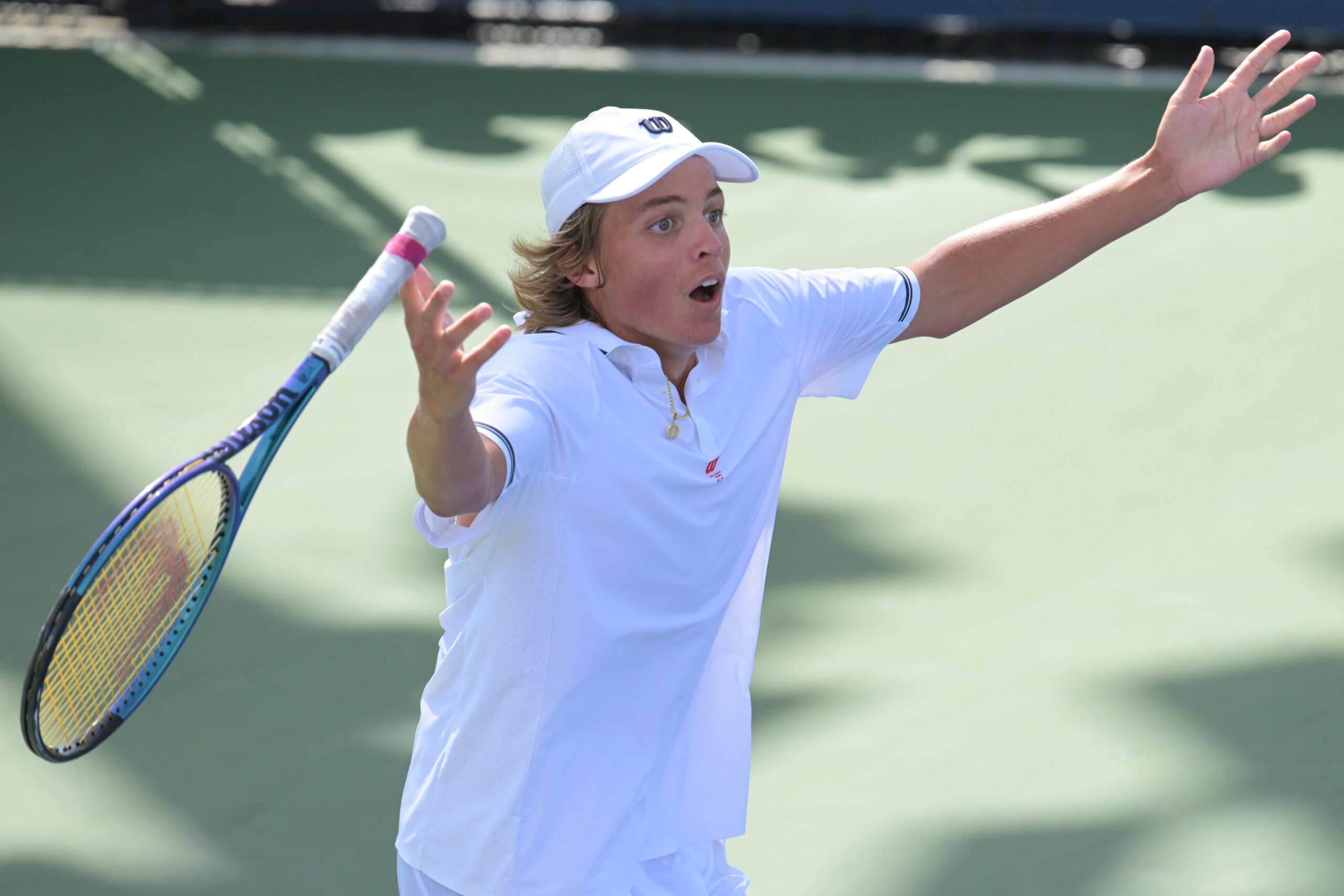
 NEW YORK. By Leo Canaparo. Photo courtesy USTA
Marcel Latak’s rise to the 2026 US Open boys’ singles title was one of the most unexpected stories of this year’s junior championships. The 17-year-old American arrived in New York unseeded and ranked No. 41 in the ITF junior rankings, but left Flushing Meadows as a Grand Slam champion and the first American boy to win the US Open junior singles title since Taylor Fritz in 2015. His run was remarkable: Latak defeated five Top 10 seeds, including Australian Open champion Keaton Hance and No. 2 seed Jamie Mackenzie, before producing a spectacular comeback against Brazil’s top seed Guto Miguel in the final. After losing the opening set, Latak fought back to win 3-6, 7-5, 7-6(13), saving championship points in an extraordinary deciding tiebreak. The victory lifted him to a career-high No. 8 in the ITF junior rankings.
What makes Latak’s story even more interesting is how quickly his development accelerated. A native of the Chicago area, he was the 2025 USTA National Boys’ 16s champion, winning the Kalamazoo final after coming back from 5-1 down in the deciding set against Andy Johnson. He also captured the J300 San Diego title in March 2026 and, immediately before the US Open, won another J300 in Repentigny, Canada. Those two tournaments gave him a remarkable run of victories heading into New York and helped him believe that he could compete with the best players in his generation.
Latak’s development has also been shaped by a major change in his training environment. Since early 2025, he has spent considerable time in San Diego, working with renowned coach Christian Groh, who has previously coached players including Taylor Fritz, Tommy Haas and Brandon Nakashima. Latak trains primarily around Rancho Santa Fe, occasionally working at San Dieguito Tennis Club in Encinitas. Groh describes him as an outstanding ball-striker with a strong serve and beautiful backhand, but believes his greatest quality is his competitiveness and fighting spirit.
There is also a fascinating personal side to Latak’s evolution. He has admitted that when he was around 11, he was not particularly interested in fitness or repetitive drills and mainly wanted to play points. Watching the progress of his older sister, Thea, and conversations with his parents, Klaudia and Rafal, eventually helped change his attitude toward training. That transformation appears to have become one of the foundations of his rapid progress. His family has also made significant sacrifices to support his development, regularly traveling between Illinois and San Diego and sometimes staying in hotels or Airbnbs during training periods.
Latak is now preparing for the next stage of his career. He has committed to Stanford University for 2027, giving him an opportunity to combine high-level tennis with a strong academic environment. Before that, however, he still has another season of junior Grand Slam opportunities ahead of him.