


 By Leo Canaparo Tennis coach and Director TENNIS7.NET
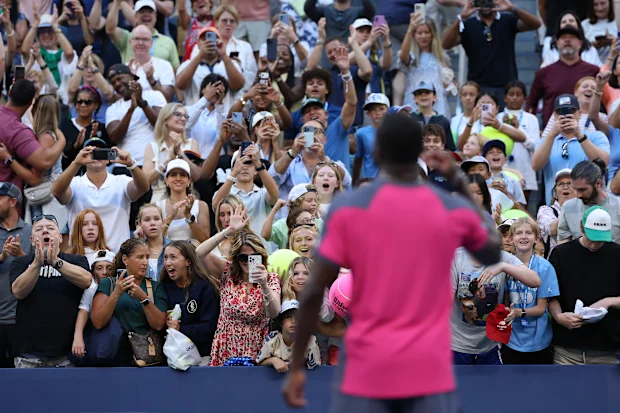
In today’s game, concentration cannot depend on silence. The best players must learn to perform while the crowd moves, talks, celebrates and sometimes becomes part of the match.
Tennis has always demanded concentration. But perhaps the definition of concentration is changing.
For decades, players were taught to create an internal bubble: control the breathing, establish a routine before the serve, avoid looking at the crowd and try to eliminate everything that was happening outside the court.
The modern game is making that increasingly difficult. The 2026 US Open has provided a powerful example. New York has always been one of the loudest environments in tennis, but this year’s tournament has taken the discussion to another level, with players complaining about noise, movement in the stands, photography, lights, heckling and spectators behaving differently from the traditional tennis audience.
And that raises an important question for coaches: Should we continue teaching players to eliminate distractions—or should we teach them to play with distractions?
I believe the answer is increasingly clear. The future belongs to players who can compete with noise.You cannot control the crowd. You can control your response
One of the first mental lessons a tennis player needs to understand is brutally simple:You cannot control what happens outside the court. You cannot control whether someone gets up during a changeover. You cannot control a spectator shouting. You cannot control the reaction of 20,000 people after a spectacular point. And you certainly cannot control the atmosphere at Arthur Ashe Stadium. What you can control is what happens after you notice it. That distinction is fundamental.
The distraction itself is not necessarily the problem.The problem is the player’s reaction to the distraction.
A player hears a noise, looks toward the crowd, becomes irritated, complains to the umpire, loses emotional control—and suddenly the distraction has lasted 20 or 30 seconds instead of two. This is particularly important because tennis is a sport of constant transitions. The player has only a few seconds between points to leave one situation behind and prepare for another. The ability to reset may be more valuable than the ability to remain perfectly focused for an entire match.
Train the distraction before the tournament. This is where modern coaching can make a significant difference.
If a player only trains in silence, then suddenly arrives at Arthur Ashe Stadium and faces 23,000 spectators moving, shouting and celebrating, the environment can become a psychological shock. The objective is not to annoy the player.The objective is adaptation.The brain needs to learn that noise does not automatically mean danger.
This concept is already familiar in other sports, where athletes have used artificial crowd noise in training to reproduce the environments they will encounter in competition.
From “quiet, please” to “play anyway”
But professional tennis is becoming more connected to entertainment, social media and younger audiences. The US Open is arguably the Grand Slam where that transformation is most visible. That doesn’t mean anything should be allowed.
Players have a legitimate right to expect that spectators do not intentionally interfere with points. Recent incidents involving influencers, lights and excessive noise have demonstrated the need for clearer boundaries. But there is an important distinction between unacceptable interference and simply playing in a noisy environment.
The second is becoming part of modern tennis.And players must adapt.
The champion doesn’t need perfect conditions.mAnd certainly not a perfectly quiet crowd.The highest-level competitor develops the ability to say:”This is the environment today. This is my court. This is my match. Now play.”That mentality changes everything.Instead of spending emotional energy trying to make the environment different, the player invests that energy in the next point.
The real goal: fast recovery As coaches, perhaps we should stop asking players:”How long can you stay focused?”

The difference is what happens afterward.A world-class competitor can be distracted for two seconds and then return completely to the present.Another player can remain mentally trapped in the distraction for an entire game.
That difference can decide a Grand Slam match.The US Open has reminded us that tennis is changing.The crowd is louder.The environment is more dynamic.
The relationship between sport and entertainment is becoming stronger.And the player who expects silence may increasingly find himself fighting the environment instead of fighting his opponent.
The solution is not to teach players to stop hearing the noise.
It is to teach them how to hear it—and keep playing.Because in modern tennis, concentration is no longer the ability to play without distractions.It is the ability to perform despite them.